That's where @Norse900's folie à deux and Dancing Plague comparison becomes really interesting. Maybe what was spreading through the convent wasn't an infectious disease at all, but behavior, expectation, fear or some kind of psychological/social contagion.
When your life is on the line for not reacting appropriately, people will do things like this. The Russian "show trials" during the Stalin era are a good example of that. Family turning on Family. Spouses on each other. I was reading the Inquisition book last night and it was talking about a lot of instances where family and spouses turned on each other out of self-preservation.
And that raises another possibility: what about the nuns themselves?
what if someone experimented with some form of spirit contact or magical material, something happened—or they believed something happened—and the whole thing snowballed from there?
Spirits mold our experiences of them to match what we already know. Leviathan to me is different than Leviathan for someone else for this reason (aspects aside, let's keep it simple). The only frame of reference these people may have had is the Catholic Church or similar. They will fit things to that known reference. Add in a little fear of the unknown, fear of demons, and fear of being burnt alive and it seems like quite the magical mix.
Did Grandier magically cause what happened inside that convent? I'm still not buying it.
He wouldn't have to. A lot of the rituals in Forbidden Rites are outdoors. How many of us have helped beginning practitioners close doors and get rid of attachments? Grandier could've just not had the ritual hygiene and the inability to feel or sense that something was amiss until an infestation happened. The evoker and the medium were separate jobs for a significant amount of time. He could've done the calling, not felt anything, and walked off without properly closing. Or he could've raised enough energy to catch the attention of some spirit in the environment that followed him. Sometimes spirits follow people home without any of that. Hard to say.
Edit - formatting
@Verdo is quite right as a legit underlying factor. It started the wig craze that was ubiquitous in at least Continental America (not trying to be US focused here). It was a problem in Europe, too, and one I hadn't thought of. I've heard of prosthetics for syphilis damage made of wood and cloth, but couldn't cite sources at this point.
If you'd like to see a modern day, drug-resistant version this video will explain that from a qualified medical professional. I am a fan of ChubbyEmu and his more technical channel.

are you thinking something along the lines of syphilis eventually producing neurological or psychiatric symptoms?
That's my best guess! If he was known for being sexually lascivious and he has this known connection to the convent via the head nun, I don't think its a leap to think that perhaps he was fooling around with some of them. I mean, the head nun probably would not have asked him to be a spiritual head in her convent if he wasn't already familiar with the people there I imagine. And if the head nun thought he was attractive enough to pursue, then he probably did have decent success with the opposite sex. Perhaps the reason he said no is because he was already too deeply involved with some of the nuns already and it may have complicated his situation...but who knows honestly....I can only speculate. Its not impossible that he really was doing some magick, and his literacy ability was more likely on the higher side too. I just know how scant the evidence tended to be with convictions like this, and having powerful political enemies increases the likelihood of him being set up. I mean, do we know how they even came up with that evidence? Pretty convenient for him to have left a piece of paper with all the boogeyman words written all over it for the authorities to find 🙄 It would've been so easy for them to have planted that.

I think both of you may be getting at the same thing: more than one explanation could be true at the same time.
@Verdo, syphilis is an interesting possibility, especially if Grandier really was involved with women connected to the convent. It could potentially explain unusual behavior in one person, and I think it is worth keeping in mind as one possible explanation. It also would not necessarily explain why the behavior seemed to spread through the convent.
@Norse900, I can also see how the ritual-hygiene idea could fit within an occult interpretation. Grandier may not have deliberately attacked the convent. If he was practicing, opened something carelessly, attracted an attachment, or failed to close something properly, the consequences might have followed without him intending harm. The nuns would then have understood what was happening through the religious framework they already knew: demons, sin, possession, and punishment.
That is what makes the case so interesting to me. Illness, occult experimentation, fear, pressure from the Church, and political motives could all have played a part. Once the accusations started, people may simply have reinforced the story they were expected to tell.
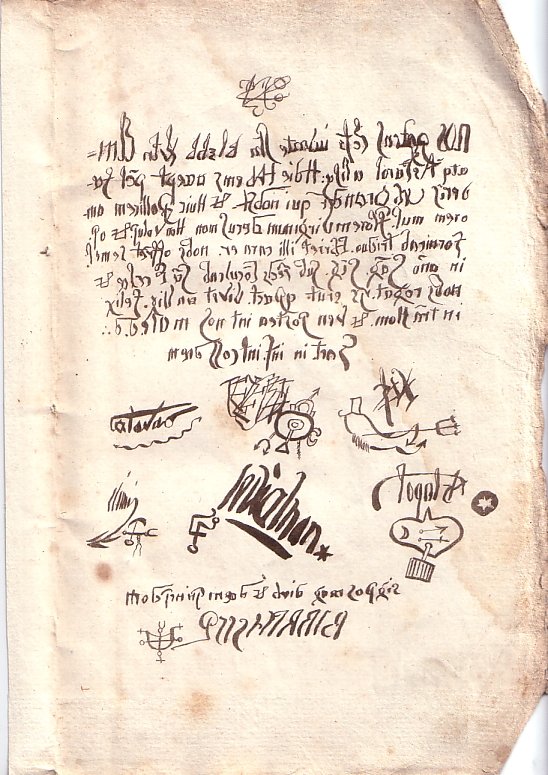
As for the pact, my position is that the version we have today was probably fabricated. It is almost too convenient, with Grandier supposedly making an agreement with every major infernal name and leaving behind dramatic signatures just when powerful people needed evidence against him. To me, it looks less like something a serious practitioner would have kept around and more like something created to convince people who already believed there was a demonic conspiracy.
The alleged pact introduced as evidence against Urbain Grandier. This image should not be treated as proof that Grandier created or signed it. Source: Wikimedia Commons; reproduced from Collin de Plancy’s Dictionnaire infernal (1826).
Figured I´d upload the pact along with signatures.